
This page provides access to a selection of books, journal articles, and earlier journalism. Material that pre-dates the digital era uses either links to digitised publisher archives (where available) or bespoke PDFs.
A Poetics of Editing
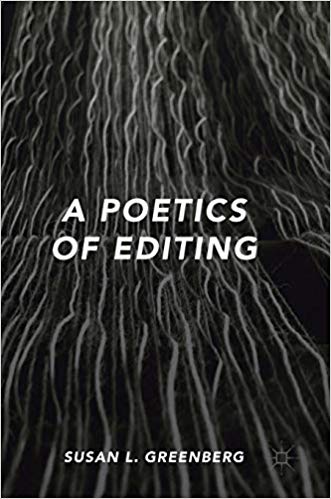
A work of history and analysis that aims to expand our understanding of editing practice and the work that the ‘idea’ of editing does in society.
A review by the scholarly association SHARP described it as offering ‘new insights into the under-represented field of editing’.
‘Wonderful … an important book’ – Prof Jerome McGann.
Published 2018 by Palgrave Macmillan.
CUP Elements Series
This strand within the CUP series on Publishing and Book Culture draws on the themes and challenges outlined in A Poetics of Editing (above), to build a field of Editing Studies. It takes a multi-frame approach that covers different periods, people, roles, genres, formats and technologies. CUP Elements uses the ‘minigraph’ format to provide a home for original, concise, peer-reviewed research.
Slow Journalism
Prospect, February 2007
Extract: Many people in Britain write fiction on the strength of the kudos they hope to win if the work gets published. Why don’t they think there is a pot at the end of the nonfiction rainbow? The main reason is the belief in Britain that literature is, by default, fiction. Occasionally, pieces of fact-based literature get reclassified as novels once they are judged to be ‘good’. Slow Journalism
Editors Talk About Editing
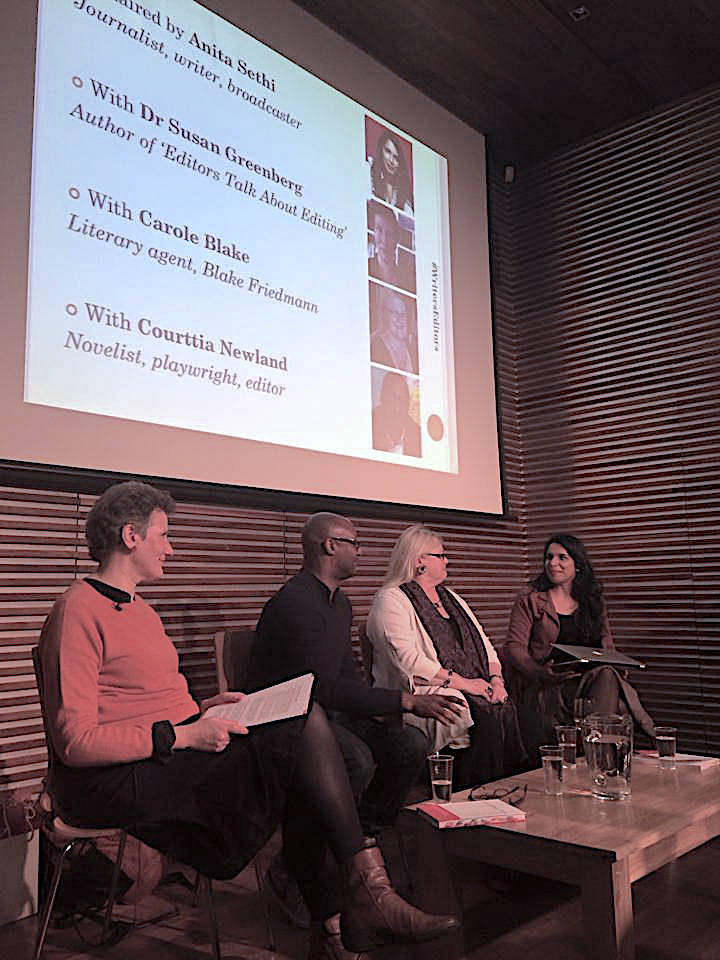
This book fills a gap by offering in-depth conversations with contemporary practitioners, across print and digital, books and periodicals, and fast (newspapers) and slow (scholarship). Published 2015 by Peter Lang.
The book was launched in London’s Free Word Centre with a panel discussion, supported by The Literary Consultancy (TLC), October 27, 2015 (see left)
Therapy on the couch
Mindfield series, Camden Press, 1999
Extract from Introduction: In a country where therapy is still relatively marginal, the anger it provokes seems staggering. Look at it from the therapist’s point of view: hundreds of people in the UK are out there, doing something not very glamorous and usually badly paid, who think they are answering a need because people in anguish come to them for help, and at every turn they are portrayed as vultures waiting to pounce on the vulnerable, manufacturing victims and undermining society in the process. No wonder many therapists are desperate to reassure the public. They want to be loved and understood, just like us all. Therapy PDF.
The great Yugoslav failure
The New Statesman, August 9, 1999
Tito’s legacy seemed to offer a “third way” between Moscow and the west. But it was the worst of both worlds. Archived article.
The meeting is the message
Prospect, February 20, 1998
Clouds of hubris are gathering over the annual meeting of the world’s most important people in Davos. Susan Greenberg says the organisers are so fearful of offending the participants that real debate has been stifled. Davos article
Backlist in Prospect magazine
When Prospect launched in October 1995, Dr Greenberg was on the original editorial board, and had an article in the very first issue. Occasional contributions continued through to 2007 for the main magazine, and 2008 for the First Drafts blog. A partial list is accessible here.
Slovakia leads celebrations on first night of divorce
The Guardian, January 2, 1993
‘For the bleary-eyed officials at Bratislava airport yesterday morning, the first-ever international flight to Prague posed something of a challenge…’ Archived article.
Uneasy sits the Czechoslovak crown
Susan Greenberg in Prague on the state bank that stands at the eye of the separation storm. The Guardian, December 19, 1992.
Extract: If the money speculators move in, or if Prague and Bratislava diverge too strongly on economic policy, they will put a special Czech stamp on old notes and change over the entire currency within two days. Tellers are reportedly hard at work, practising their wrist action while men with stop-watches record how long it takes. They have already discovered that the stickers get stuck when the money goes through a counting machine. There’s nothing secret behind these preparations, just a keen interpretation of an agreement which spells out the grounds for any future currency split – a set of “divergence criteria”, which mirrors the monetary convergence criteria of the Maastricht treaty. Crown PDF
The reburial of Imre Nagy
A passage in the original English, from A L’Est: La Memoire Retrouvé, edited by Alain Brossat, Sonia Combe, Jean-Yves Potel, Jean-Charles Szurek, Editions La Decouverte, Paris 1990.
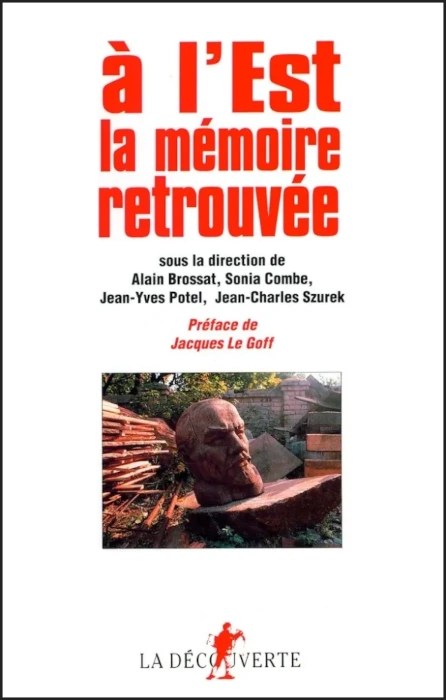
Extract: The textbook covering modern history, Number Four in the series, was being rewritten. The edition it is replacing, used by a generation of Hungarian schoolchildren, describes 1956 as a ‘counter-revolution’. I want to meet the person responsible for this canonical text and in the small world that is Budapest, it is not hard to get a name. I expect to find a hard-bitten party stalwart, but meet instead a disillusioned and well-meaning woman. Agota Joverne Szirtes is happy to talk, and put her side of the story. Nagy PDF